ASKYM · RESEARCH · SEPTEMBER 2026

Everything our means make possible

“What is this situation a means to?”

Can an AI explore all of it, well beyond what a human group can envisage? An exploratory research programme, its open questions, and what Google Research has just shown on a neighbouring subject.

Quentin Tousart · askym.aiASKYM

The starting point

We do not see what our means make possible

An effect can follow from what we already have and stay out of sight for years.

Our cognition tracks interactions poorly. As soon as several means combine, we envisage only a handful of connections, often the most familiar ones. Herbert Simon named this limit bounded rationality.

We call this cognitive myopia: the possibilities are there, blurred or out of frame.

“What is this situation a means to?”

The question that corrects this myopia, one situation at a time. It forces us to describe what we have before looking for what it makes possible.

This programme asks how far an AI can carry this question, first on one situation, then on many.

Bounded rationality: Herbert Simon. The question comes from Dominique Vian's ISMA Concept method.ASKYM

Two logics

The inverted question

CAUSAL LOGIC Means End we seek what is needed “Which means for this end?” The end is known. This is the logic of most tools. EFFECTUAL LOGIC Means Effects we seek what they enable “What is this situation a means to?” The means are there. We have not found a tool at this scale.
Sarasvathy 2001 for the distinction; Dominique Vian's ISMA Concept method for the question.ASKYM

Twenty-five years of research, a method practised with humans

The method, by hand

The expert entrepreneur starts from what they have: who they are, what they know, whom they know. The goal comes later, along the way.

STEP 1

Clarify

Describe the situation as a fact, through its properties, before any use. An induction: generalise its essential properties, those it cannot lack, until what they form can be named.

STEP 2

Explore

A deduction: apply a general rule to the induced properties, and infer an effect from them. Keep what the situation makes possible, directly and immediately.

STEP 3

Hierarchise

Look for the essential function of each effect, the one it cannot lack: an induction, tested pair by pair. Does A enable B, and only B? Three to seven higher-level effects remain.

In a workshop, a group runs these three steps on one situation at a time. ASKYM has turned them into software components, with an LLM as assistant and a human who decides.
Theory: Sarasvathy, “Causation and effectuation”, Academy of Management Review, 2001. Protocols of the 27 founders: Sarasvathy 1998, taken up in Effectuation, 2008. ISMA Concept method, Dominique Vian, SKEMA.ASKYM

An example across the steps

The glove

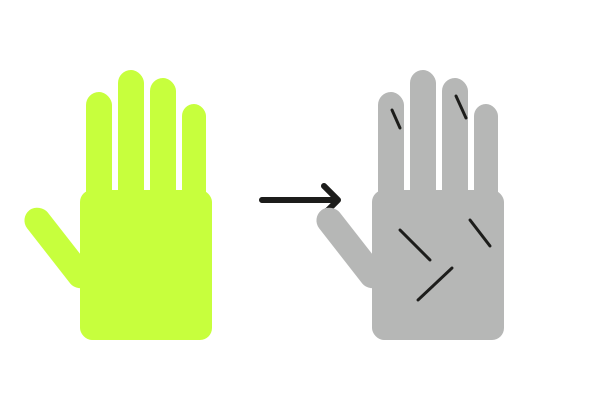
A lime-green glove and a hand-shaped ice cube

CLARIFY · THE PROPERTIES, THEN THE NAME

A glove, described without its use: the shape of a hand, watertightness. Nothing about heat, nothing about washing-up. Generalised: a watertight hand-shaped container.

THE RULE

What has a shape and holds contents can serve as a mould.

EXPLORE · A DIRECT EFFECT

Hand-shaped ice cubes. A possibility that the usual use concealed.

This reasoning concerns an object, its properties, and what they make possible. That is why it can be tried outside the company, on any object whose properties can be listed.

Teaching example from L'intelligence des possibles (The intelligence of possibilities, Vian). The generalised name is added here to show step 1.ASKYM

The research hypothesis

Can an AI be made to do it?

We would give it a situation. It would describe its properties, name what they form, look for what this set makes possible, order the effects. The three steps of the method, chained without intervention.

FIRST ON ONE SITUATION

Each step would take the output of the previous one. The traces would have to stay readable from end to end.

THEN ON MANY

Ten, fifty situations, linked by their shared effects. In a workshop, a group handles one at a time.

A HUMAN, AND LIMITED TIME

The AI would generate on its own. A human would validate afterwards, or assist along the way in a variant. Their time would become the bottleneck.

This is a hypothesis. The complete chain has never run; only isolated components have been tried. What follows says how we would test it, and what would make us stop.

ASKYM research programme, September 2026. Method: Dominique Vian, ISMA Concept.ASKYM

Step 1 · induction · two open questions

Clarify: describe, delimit, name

What the method does

Describe the situation as a present fact, without cause, without solution, without judgement. Decide what is treated as a whole. Then an induction: from what is observed, generalise the essential properties, those the object cannot lack, until what they form can be named. The glove becomes “a watertight hand-shaped container”.

As the book puts it: “this semantic work is not incidental, it is the induction itself”. In this programme, exploration would start from this generalised description, written down in black and white.

QUESTIONS PUT TO THE AI

1. Can it induce this name without reintroducing the use? “A glove protects the hand” is already a use.

2. Who chooses the scope: a human, or the AI comparing several ways of carving it up? The properties depend on the scope, so the two questions are linked.

MEASURE fidelity of the name to the properties, absence of presupposed use, agreement of practitioners judging blind.

Induction in the sense of L'intelligence des possibles, §2.4 and §4.1: moving from particular observations to a general characterisation of the essential properties, without going through causes or use. Precedent for the test “does my description imply a use?”: McCaffrey, Psychological Science, 2012.ASKYM

Step 2 · deduction · two open questions

Explore: what this set makes possible

What the method does

A deduction: apply a general rule to the induced properties, and infer an effect from them. “What has a shape and holds contents can serve as a mould”: the glove makes hand-shaped ice cubes possible. We keep what the situation makes possible, directly and immediately, never what it contributes to.

For an AI, the rules would come from two sources. Connections already made by others, in texts, patents, databases. And analogy, when the object is new: start from the effects of a more general object, remove those its constraints rule out.

QUESTIONS PUT TO THE AI

1. What is actually found in the corpora, and what does the model invent?

2. An added property removes effects. Two properties joined together open some up: shape and watertightness make the mould. How do we account for both?

MEASURE number of distinct effects, share judged direct, immediate, exclusive by practitioners, already-known effects recovered.

An external reference point. On CreativityBench, ten LLMs pick the right object to repurpose in 51% of cases. They justify the right part and the right property in 19%. This benchmark measures the repurposing of objects under constraint. Exploration without a goal remains to be measured.
Qian et al., “CreativityBench”, arXiv:2605.02910, 2026: object accuracy 0.51, full accuracy 0.19, averaged over ten models, as reported by the authors. Simon, after Vian: constraining narrows the field of possibilities. Precedent for the recursion: network expansion (Handorf, Ebenhöh and Heinrich, J Mol Evol, 2005), with rules written in advance.ASKYM

Step 3 · induction, then test · two open questions

Hierarchise: which of these effects enables which?

What the method does

Set aside what contributes without enabling. For each effect, look for its essential function, the one it cannot lack. This is an induction, as in step 1, applied to an effect, and it is tested pair by pair. Does A enable B? Does A enable only B? When the answer is yes, A becomes the means to B, and B remains available as a means to a higher effect. The tree rises to three to seven higher-level effects. A disputed link is not intersubjective, and it is dropped.

Twenty effects make 380 ordered pairs. Our internal benchmark in September, on fifteen models, flagged a drop on these tasks. It did not evaluate the complete chain.

QUESTIONS PUT TO THE AI

1. Is sharing a function enough to establish “A enables B”?

2. Does a closed-answer judge, yes or no with its probability, do better than a model that writes free text?

MEASURE trees already labelled by practitioners, compared branch by branch; overall consistency, absence of cycles.

Pairwise association mechanism and essential function, L'intelligence des possibles, §4.3, which sets the output of the step at 3 to 7 higher-level effects. Precedent for pairwise association: Interpretive Structural Modeling, Warfield, 1974, without an exclusivity test. ASKYM benchmark of 3 September 2026, fifteen models, isolated tasks.ASKYM

A neighbouring system, published on 26 August 2026

Google's Planetary Prediction Engine

What it is

A system from Google Research, PPE for short. It is asked a question about the planet in everyday language: “Which areas of Nigeria are at risk of food shortage?” It chooses the data, fuses them, trains a model and writes the report. Nobody intervenes between the question and the report.

How it goes about it

Three stages orchestrated by an LLM: data selection, curation, model and prediction. The details are in the appendix.

WHY MENTION IT HERE

1. A major laboratory reports that an entire chain runs without a human, on real data. This is the kind of autonomy our hypothesis assumes.

2. Its chain starts from a target and looks for the data that predict it. Ours would start from the means and look for what they make possible. Same architecture, opposite direction.

Ma, Pasumarthi et al., Google Research, arXiv:2608.26088, 26 August 2026 · experimental system, no public access.ASKYM

Planetary Prediction Engine · Google Research · 26 August 2026

What its authors report

Three questions put to the system, three reports, compared with the baselines of each domain.

Question STAGE 1 Data selection STAGE 2 Multimodal curation STAGE 3 Model and prediction Report

NIGERIA · FOOD SECURITY

66.1%

of variance explained when moving down from state level to local level, against 31.5% for the baseline.

DRC · EBOLA 2026

15 of 18

newly affected health zones recovered across five weekly forecasts, ten points better than the best published model.

UNITED STATES · 21 HEALTH INDICATORS

76.8%

of variance explained on average, against 60.0% for pipelines hand-tuned by experts.

Ma, Pasumarthi et al., Google Research, arXiv:2608.26088, 26 August 2026 · figures reported by the authors, not independently reproduced · experimental system, no public access.ASKYM

Our reading of its scope

What it does not do

Fixed target QUESTION Data · model · ground truth Prediction and now?

The target is set by the question

The engine looks for the means to an already known end. It cannot discover an end. Anything that does not predict the target is set aside, even if it is valuable for something else.

It predicts where and how much

It does not say what to do. The report stops where the decision begins. It is up to humanitarian actors to turn a risk map into action.

It evaluates itself without a human, thanks to a ground truth

We know after the fact where the shortage occurred, so its predictions are measured automatically. Where nothing settles the matter after the fact, this loop does not exist.

ASKYM's reading of the PPE report. These three points are our interpretation of its design choices.ASKYM

Google's chain, and ours in the opposite direction

The architecture to test

PPE · FROM AN END A target question asked The data predicting the target A model fusion, training Ground truth R², recall, automatic A prediction where, how much EFFECTUAL ENGINE · FROM THE MEANS A situation its data read as an inventory Clarify properties, scope, name Explore effects, under conditions Hierarchise which enables which Retained possibilities which become situations again HUMAN INTERVENTIONS: TRACED, COUNTED, TIMED A RETAINED EFFECT IS A SITUATION AGAIN
The PPE closes its loop on a ground truth. Here, no exhaustive reference of the possibilities exists: some proposals would be verified locally, the rest would be assessed by judges.ASKYM

Same layers as the PPE's Nigerian and Congolese cases · market prices · price anomalies · rainfall · vegetation · night-time lights · roads · buildings · health centres · mobility

The same data, two outputs

PPE OUTPUT · illustrated form

A risk map by local area, and the signals that predict it

Area Z: high risk.

Signals retained: maize price anomaly, rainfall deficit, low night-time activity.

The decision belongs to those who read it.

ENGINE OUTPUT · illustrated form, not computed

An inventory of means, then a few effects per area, with their chain

Area Z: maize price low here, high in the neighbouring area; passable road between the two; a warehouse.

Properties: price gap, link, storage capacity. Effect: a pooled purchasing reserve between the two areas.

A health centre, a passable road, known travel to the neighbouring area.

Properties: care capacity, link, flow. Effect: a forward screening point, with no new infrastructure.

The two could be chained. The PPE says where it will hurt. The engine would say what the place already has to respond with. The goal “food security” would keep the pooled purchasing reserve and set aside the screening point, without having dictated either. Local actors would validate, one phone call at a time.

Data layers: those the PPE authors cite for the Nigerian case (prices, vegetation, rainfall, night-time lights) and for the Congolese case (roads, buildings, health centres, mobility). Both outputs illustrate a form: area Z comes neither from the paper nor from a computation; neither system has run on these data.ASKYM

What the engine would return, and to whom

What it would be for

A short list of combinations to act on

Each line would hold four elements: the means we own, the property we use, the effect we reach, the stakeholder who can confirm it.

Three filters would make it usable as is. Direct, held by a means already there. Immediate, actionable without acquiring anything. Exclusive, specific to this situation.

For humans. Faced with a problem beyond them, seeing an action within their reach that they had not seen.

For an AI. An agent that knew what its means make possible would choose better what to attempt. The engine would explore and propose. Execution would fall to another system.

ENTREPRENEUR

An action plan drawn from their means, with no prior business plan.

TERRITORY, INCUBATOR

An inventory of means read as a reservoir of possibilities to confirm.

LABORATORY

Latent protein functions to test, ranked by information value.

INDUSTRIAL PROPERTY

Unclaimed uses of a patent, to file or to license.

The three filters come from the ISMA Concept method. Use by an AI agent is a lead still to be investigated.ASKYM

World model, action model, LLM: where the engine sits

Five families, five questions

LLM

“What is usually said about this?”

INPUT a text

OUTPUT the likeliest continuation

GOAL in the prompt

Proposes by association. The sorting remains to be done.

WORLD MODEL

“What happens if I do X?”

INPUT a state, an action

OUTPUT the next state

GOAL elsewhere, in the planner

Simulates the consequences of a choice already made.

DreamerV3 · V-JEPA 2 · Genie 3

ACTION MODEL

“How to execute goal X?”

INPUT a goal

OUTPUT clicks, tool calls

GOAL given at the start

Executes a goal it is given.

Computer use · Large Action Models

PPE

“What value does the target take, here?”

INPUT a target, layers

OUTPUT a prediction

GOAL at the start: the target

Predicts where and how much, stops there.

EFFECTUAL ENGINE

“What do these means make possible?”

INPUT means, their properties

OUTPUT effects, then combinations

GOAL afterwards, to filter

Would look for what can be done before knowing what to aim at.

Stakeholders would validate. Each effect they keep would become a means again.

The engine would sit upstream of the others: its output would be the space of options that an action model executes and a world model puts to the test. In our reading, none of them starts from means without a goal. We want to evaluate what an explicit chain doing so would add.
DreamerV3: Hafner et al., Nature, 2 April 2025. V-JEPA 2: Meta, 11 June 2025. Genie 3: Google DeepMind, 5 August 2025. Computer use: Anthropic, 22 October 2024. Large Action Models: Microsoft, arXiv:2412.10047, December 2024. “LLM-Modulo”: Kambhampati et al., 2024. Curiosity-driven open-ended exploration, the family closest to our question 2: Flowers, Inria Bordeaux (Etcheverry 2023).ASKYM

The programme · three questions that nest together

Compute, orient, validate

QUESTION 1

Compute the chain

The three steps, each with its measure. The effectuation literature does not compute means → effects; biochemistry does, in the forward direction (network expansion, underground metabolism), without redescription, without exclusivity, without hierarchy. It is these three steps that we would measure, against that baseline.

MEASURE known-answer corpora.

QUESTION 2

Orient without closing off

The goal would come after the effects, to filter them. Part of the budget would stay blind to the goal, so that the unexpected keeps coming.

MEASURE the cost of the goal: what is gained in speed, what is lost in discoveries.

QUESTION 3

Validate without slowing

Agreement between judges would establish a shared judgement; feasibility would be verified elsewhere. At what throughput does the human start to limit the chain?

MEASURE links validated per hour, depending on the prioritisation strategy.

State of the art as of 19 August: Co-Scientist, FutureHouse, GNoME on the discovery-AI side; Silberzahn and Vian 2022 and 2026 on the effectuation side; quality-diversity (Lehman and Stanley 2011) for question 2. Precedents by step, reread on 22 September: McCaffrey 2012 (describing without the use), Handorf, Ebenhöh and Heinrich 2005 (network expansion), Barve and Wagner 2013 and Notebaart et al. 2014 (underground metabolism), Warfield 1974 (pairwise hierarchisation), Etcheverry 2023, Flowers Inria Bordeaux (human-guided open-ended exploration).ASKYM

A first test, to be built

How we would test it

DIRECT GENERATION

The question is put to an LLM as is, without the method.

AUTONOMOUS CHAIN

The same model runs clarify, explore, hierarchise, without intervention.

ASSISTED CHAIN

The same chain, with a human at the checkpoints.

WHAT WE WOULD LOOK AT

The effects that practitioners retain when judging blind, and how many.

WHAT WE WOULD COUNT

The errors: reintroduced uses, false links, invented properties.

WHAT WE WOULD TIME

Human time, with assistance and validation counted separately.

Three outcomes, to be defined before launch: a gain too small to continue, a measure to be revised if the judges do not agree, a result that justifies going further.
Pilot envisaged on some twenty situations, same model and same budget for each arm, including cases with known answers (two-function proteins, patents with masked claims). No results to date.ASKYM

And now

What we would like to discuss

DOES THE QUESTION HOLD?

Well-founded or naive: either answer helps us.

WHAT ALREADY EXISTS?

Related work we may not have read, on induction, analogy or hierarchisation.

WHERE TO START?

A first test, tiny and real: one situation, its means, and a phone call to check.

Quentin Tousart · ASKYM · askym.ai

ASKYM exploratory research programme, September 2026 · method: Dominique Vian, ISMA Concept.ASKYM

Going further

Appendices

A

How Google's system does it

Three stages orchestrated by an LLM, and its Feature Gate.

B

Nested situations

Everything is a situation: the planet, the territory, the company, the molecule.

C

What is this protein a means to?

Structural biology.

D

What is this patent a means to?

Industrial property.

Slides carried over from the first version of the deck, 15 September 2026.ASKYM

Planetary Prediction Engine · three stages orchestrated by an LLM

How it does it

STAGE 1 · DATA SELECTION

The question becomes constraints

Territory, grid resolution, period. The system forms hypotheses about useful signals, checks them against the literature, then fetches the data from Data Commons, Earth Engine and, failing that, from public portals.

STAGE 2 · MULTIMODAL CURATION

Fusion, then a leakage filter

The data found are fused with geospatial embeddings of population and imagery. A Feature Gate removes anything that would leak the answer into the data: sub-components of the target, downstream effects, future data.

STAGE 3 · MODEL AND PREDICTION

Several families of models

Regularised linear models, boosted trees, perceptrons. An overfitting guard reruns the computation when generalisation fails. The report is written at the end.

Data Commons · Earth Engine · open web PDFM embeddings · AlphaEarth FEATURE GATE linear · boosted trees · perceptron OVERFITTING GUARD

Keep the Feature Gate in mind. A filter that prevents the answer from already being in the data. The effectual engine needs a filter of the same kind, turned the other way: at step 1, no property may contain the use being sought.

arXiv:2608.26088, §2 · PDFM = Population Dynamics Foundation Model; AlphaEarth = annual satellite embeddings.ASKYM

Everything is a situation

Nested situations

THE PLANET the PPE layers A TERRITORY a business park A COMPANY an entrepreneur, a laboratory A MOLECULE a protein A SITE ZOOM IN ZOOM OUT

For the method, everything is a situation: the state of the planet, the territory, the company, the protein, and they nest within one another. At each level, the same question and the same three steps: clarify, explore, hierarchise.

ZOOM IN

Enter a situation contained within this one, and draw out what it makes possible. From the planet to the molecule, our hypothesis is that the reasoning does not change, and that only the means change.

ZOOM OUT

Carry a selected effect back up as a means of the situation that contains this one. This is the recursion of the method.

The protein is the case where the generalisation can be tested most directly. Its properties are measured rather than induced, and nature settles what it makes possible. The uncertainty is then concentrated in the inference.

Nested situations: Dominique Vian's reading, feedback of 21 September; zooming in / zooming out from the ISMA Concept method; two regimes of phase 1 (measured, induced) in the transposition document of 18 August.ASKYM

Generalisation · structural biology

What is this protein a means to?

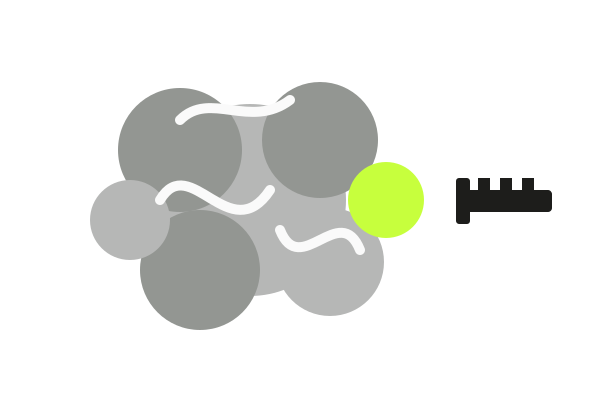
A stylised protein with a lime-green pocket and a black ligand

Drug discovery asks “which molecule for this target?” The engine would turn the question around: a protein described by its properties, pockets, charges, flexibility, without its known function, and what those properties make possible.

KNOWN-ANSWER CORPUS · MOONLIGHTING PROTEINS

One and the same protein, two documented functions. The crystallins of the eye lens are enzymes recycled as optical proteins. We mask the second function and measure whether the inference recovers it.

function 1, known function 2, masked INFERENCE recovered?

In systems biology, the inversion exists at the scale of the whole network: underground metabolism computes the nutrients a network would make possible without having been selected for them, then laboratory evolution settles the matter. We want to test the same inversion on a component described without its function, with explicit chains that can be criticised link by link.

MoonProt database (moonlighting proteins); upstream, non-native substrates predicted and then obtained by evolution: Barve and Wagner, Nature, 2013; Notebaart et al., PNAS, 2014; Canalejo and Nogales, bioRxiv, Dec. 2025. Neighbouring field: systems biology (Aderem, Cell, 2005; Hartwell et al., Nature, 1999). Safeguards: splitting by families, control for popularity bias, leakage in the training corpora.ASKYM

Generalisation · industrial property

What is this patent a means to?

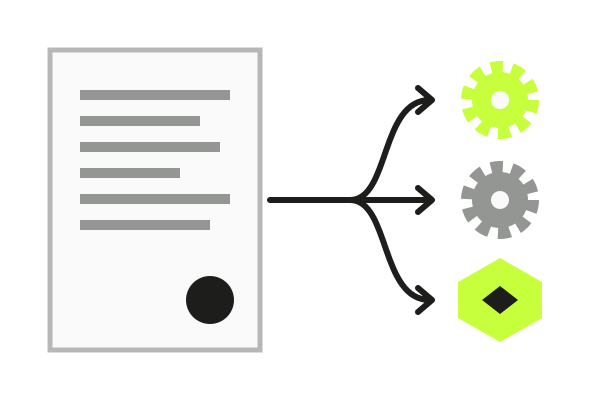
A patent document with an arrow leading to three uses

A patent described by its properties, without its claim. The engine would propose the uses those properties make possible. A clue to the surplus already exists: a patent later cited by patents from another technological class has served a purpose other than the one intended.

1980 the patent is filed THE ENGINE proposes surplus uses 2005 citations from another class document the unforeseen use

The measure already exists in the literature, after the fact. The engine would aim to produce it beforehand. Mandatory safeguard: de-identify the patents, so that the model infers rather than remembers.

Mastrogiorgio and Gilsing, Research Policy 45(7), 2016: an “exapted” patent is cited by patents from another technological class. Timeline dates given as an example.ASKYM